Ransley Turf November Lawn Care Guide: Preparing Your Lawn for Winter
Frost, fallen leaves and moss: the November jobs that decide how your lawn comes out of winter, plus the feeds and iron treatments we use on our own turf fields.
November is the handover month. Growth slows to almost nothing, the ground stays wet for days at a time, and every job you do now is less about making the lawn look better this week and more about making sure it comes through winter intact.
Below is what we are doing on our own lawns and turf fields in Kent this month, with the products we use for each job.
November at a glance
- One last cut, high and on a dry day, if the grass is still growing.
- Feed for roots, not leaf, with a low-nitrogen, high-potassium autumn feed.
- Treat moss now, with iron, while it is still growing.
- Clear leaves every week, not once a month.
- Stay off the grass when it is frosted, frozen or waterlogged.
- Skip scarifying and deep aeration until spring if frost is on the way.
- Order seed, topsoil and turf now so you are ready to go in March.
What November weather does to a lawn
Chilly mornings, damp air and early frosts change the rules. Grass roots are still working, but top growth has almost stopped. Short daylight means the plant simply cannot repair damage the way it does in May.
Constant moisture is the bigger issue. Wet soil holds little air, so roots sit in poorer conditions, moss and algae get the advantage, and any traffic leaves a mark that stays until spring. That is why November is about protection and light maintenance, not renovation.
Mowing: the final cut of the season
For most gardens, your next cut will be the last one of the year.
- Raise the blade by one or two settings. A high topping tidies the lawn without opening it up to moss and disease.
- Cut on a dry day, and never mow a frosty or waterlogged lawn. You will tear the grass rather than cut it, and the tracks will still be visible in April.
- Follow the one-third rule as always. If the grass has got long, take a little off at a time rather than scalping it in one pass.
- Service the mower before you put it away. A clean underside, sharpened blade and fresh oil now saves a rushed job in the spring.
Feeding: the right food for the wrong season
This is where most November mistakes happen. A high-nitrogen spring feed now pushes soft, sappy leaf growth that frost will burn and disease will find. What the plant actually needs in November is phosphorus and potassium for root strength and hardiness.
- For a straightforward autumn feed, use a 3-12-12 Nutrigrow Autumn Fertiliser Blend 20kg. Low nitrogen, high potash, exactly the balance for hardening the sward before winter.
- Professional and large-area lawns do well on the 3-12-12 Nutrigrow Autumn Turf Pro Compound Fertiliser 20kg, which is the compound version of the same idea.
- If you would rather feed through the leaf, Autumn-Gem 4-2-16 Foliar Fertiliser 10L is taken up through the leaf tissue, so results show faster. Spray it from August to November while the grass is still actively growing, and not onto frosty or drought-stressed turf.
- Where you want a slower, phased release that keeps working through the winter, Nutrigrow 18-3.5-8+1Mg Phased Release Fertiliser 20kg releases nutrients gradually instead of all at once.
Feed on a dry, mild day when rain is forecast within a couple of days to wash the granules in, and never onto frozen ground. You will find the full range under lawn fertilisers.
Moss control: iron, and nothing harsher
Moss does not mind cold, wet and low light. Your grass does. That is why moss quietly takes over between November and February, and why the treatment you choose now matters.
Iron sulphate is the answer in November. It knocks moss back without ripping up the surface, hardens the sward, deepens the colour of the grass and helps against fusarium patch. What it does not do is damage turf that is already struggling.
- For spraying or a watering can, Easy Flow Soluble Iron Sulphate 25kg dissolves cleanly and covers a large lawn economically. Mix to the rate on the pack.
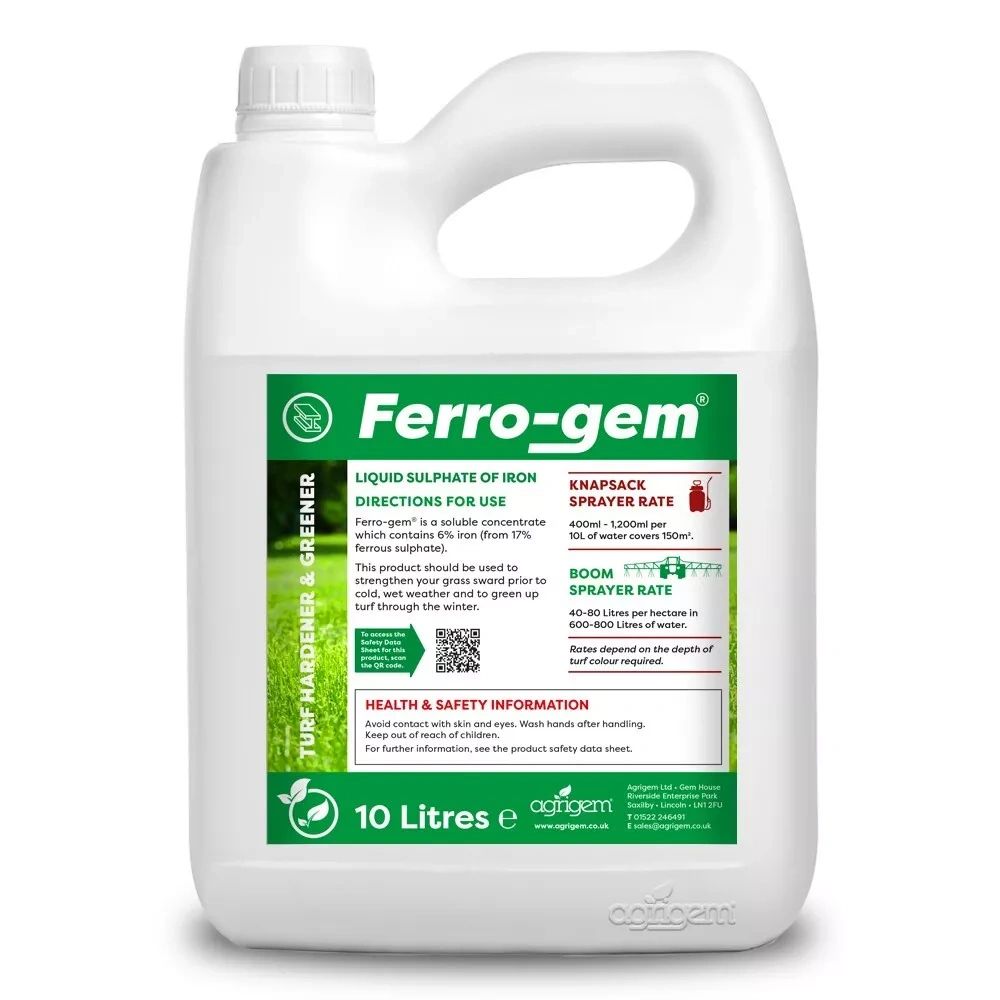
- For a ready-made liquid, Ferro-Gem Liquid Iron is simple to apply at medium strength and gives an even cover with no mixing.
- On bigger lawns and rough grass, 6-5-10+Fe Nutrigrow Moss Top 20kg feeds and controls moss in one pass.
- On damp, shaded, compacted ground, Lawn Sand 3-0-0 +7Fe 25kg combines iron with a sandy dressing that helps the surface drain and firm up.
A few practical points. Moss will blacken over one to two weeks after treatment, and that is the moss dying, not your grass. Leave it in place: raking or scarifying it out now leaves bare ground that will not recover before spring. Do not apply iron onto frozen ground, do not apply before heavy rain that could run off, keep it off paving and patios because it stains, and wear gloves.
Weeds: leave them alone until spring
Late autumn is the wrong time to spray for broad-leaved weeds. Weeds and grass are barely growing, so selective weed killers do very little except waste money, and you risk stressing turf that cannot repair itself.
If the odd dandelion is offending you, dig it out by hand. Everything else gets sorted in spring, once the lawn is growing properly again. Our weed killers are there when the time is right, and the weed and moss control guide explains which product suits which job.
Leaves, footfall and the problems to watch for
- Clear leaves weekly. A thick, wet blanket of leaves blocks light and air, traps moisture and invites disease. It also encourages worms to the surface, which brings cast after cast.
- Keep off frozen and waterlogged turf. Walking on it compacts the soil and snaps blades that will not regrow until spring. Put a plank down if you have to cross a border lawn.
- Brush worm casts off when they are dry, rather than smearing them across the surface.
- Watch for fusarium patch: small orange-brown patches that grow quickly in damp, mild weather. An iron application helps, and good airflow helps more.
- Lawn rust shows as orange dust on the mower and shoes. It is usually a sign of slow growth and low nutrition, and a correct autumn feed deals with it.
Planning for the spring now
The best lawns are the ones planned in November. If the lawn is thin, patchy or shaded out, decide now whether you are overseeding or starting again, and have everything on site so the first dry week in March is not wasted.
- Premier Landscape & Lawn Grass Seed for overseeding and repairs, with the full range under grass seed.
- Bulk Bag Topdressing to level hollows and build a better surface before seeding, plus our topsoil range for new beds and lawns.
- If the lawn is beyond saving, winter is actually a fine time to get turf ordered for the spring, and late winter into early spring is the ideal window to lay it.
Where to buy
Everything in this guide is in stock and can be ordered online for delivery or collection from the farm in Mersham. Browse the full range under lawn fertilisers, moss and weed killers, grass seed and topsoil, or read the rest of our lawn care advice.
Thanks for reading the Ransley Turf November lawn diary. If you are local, collection from the farm is usually the quickest way to get started, and delivery is available across Kent and the wider area, with longer lead times during our busy periods.